





Book Now : 1-844-360-1553
Belize Reservations Office
Phone: +501-226-4297
Phone: 1-844-360-1553
WhatsApp: +501-670-4811
E-mail: [email protected]


Close
Belize Reef & Water Adventures
21 Marine Creatures of Belize to Look for on the Reef
Dec 27, 2019
One of the best parts of visiting Belize is discovering what lives beneath the Caribbean Sea. Look into the turquoise water, and you may catch a flash of yellow behind the coral, watch a sea fan bend with the current, or notice a stingray resting so quietly in the sand that you almost swim right past it.
The marine creatures of Belize are one of the best reasons to spend some of your vacation in the water. The Belize Barrier Reef stretches along the country’s coastline, creating habitat for hundreds of species of fish along with corals, sharks, rays, sea turtles, crustaceans, marine mammals and plenty of smaller creatures that are easy to miss if you’re not looking closely.
For visitors staying on Ambergris Caye, much of this underwater world is only a short boat ride away. Snorkeling and diving give you some of the best opportunities to explore it, but sometimes all it takes is a walk to the end of a dock. Small reef fish, stingrays, and other marine life can occasionally be spotted moving through the clear water and shallow seagrass beds along the coast.
Before you head underwater, here are 21 marine creatures and reef inhabitants worth watching for in Belize.
Want to understand the ecosystem they call home? Start with our guide to the Belize Barrier Reef.
Corals and Reef Builders of Belize
At first glance, coral can look like colorful rock or even an underwater plant. Look a little closer, though, and you’re seeing colonies made up of tiny animals called polyps.
Together, these colonies create much of the structure of the reef, forming places where fish can feed, hide, and grow.
1. Brain Coral
Once you see brain coral, the name makes perfect sense. Deep grooves twist across its rounded surface in maze-like patterns that look remarkably similar to the folds of a human brain.
Brain corals are stony corals that build hard calcium carbonate skeletons. Large colonies grow slowly over many years, becoming part of the physical structure of the reef.
2. Sea Fans
Watch a sea fan for a few seconds and you’ll see why the reef never feels completely still. Its broad, flexible branches sway back and forth with the movement of the water while tiny fish move around and behind it.
Sea fans are not plants. They are a type of soft coral made up of colonies of tiny animals, and their flexible structure allows them to bend with the current rather than remain rigid. They’re beautiful to photograph but delicate, so admire them without touching them or brushing them with your fins.
3. Elkhorn Coral
The broad, branching shape of elkhorn coral resembles a set of elk antlers reaching out across the reef. In shallow water, those thick branches can create an impressive underwater landscape.
The spaces between the branches also provide shelter for young fish and other small reef animals. Large formations help create reef structure and can help reduce some of the energy from waves passing over shallow reef areas.
4. Pillar Coral
Instead of spreading outward in branches, pillar coral grows upward in tall, rounded columns. A large formation can look almost like an underwater city rising from the reef.
Its appearance becomes even more interesting when you get closer. Pillar coral is one of the corals whose polyps may extend during the day, giving its surface a soft, almost fuzzy appearance.
5. Fire Coral
This is one reef inhabitant that deserves plenty of personal space. Fire coral may look like coral, but it is actually more closely related to hydroids and jellyfish than to true corals.
Its tiny stinging structures can cause an unpleasant burning sensation if touched. It is one more reason to follow one of the simplest rules of snorkeling and diving: enjoy the reef with your eyes, not your hands.
Colorful Reef Fish of Belize
Then there are the fish. Sometimes a school flashes by all at once; other times you’ll notice a single fish tucked beneath a ledge or cruising slowly above the coral.
A little patience makes a difference. Instead of swimming quickly from one patch of reef to the next, slow down and watch what is happening around you.
6. Sergeant Major
With yellow-and-silver bodies crossed by bold black stripes, sergeant majors are among the easier reef fish to recognize.
You may not even need a snorkeling excursion to find one. Around Ambergris Caye, sergeant majors can sometimes be spotted in the clear water around docks, making them a good first introduction to the marine life surrounding the island.
7. Banded Butterflyfish
The banded butterflyfish is a small reef fish marked by distinctive black bands running vertically across its body.
Adults can be seen alone or in pairs, and they may also gather in groups while feeding. Their tendency to form long-lasting pairs is one reason they appear in our guide to monogamous animals in Belize.
If you do spot two staying close to one another on the reef, take a moment to watch how they move together.
8. Queen Parrotfish
A queen parrotfish can be hard to ignore when its blues, greens, and other tropical colors catch the sunlight underwater. But its most interesting feature may be its mouth.
Its parrot-like “beak” is formed from fused teeth, which it uses to scrape algae from coral and other hard reef surfaces. As parrotfish feed, bits of calcium carbonate reef material can pass through their digestive systems and eventually be released as fine sand.
So the next time one cruises past, remember that it is doing more than adding color to the reef.
9. Lionfish
With long, flowing fins and dramatic stripes, lionfish are undeniably beautiful. They’re also an invasive species in the Caribbean.
Lionfish prey on native reef fish, and their venomous spines help protect them from predators. Belize has used targeted removal, including efforts involving fishers, divers and restaurants, as one method of helping control their numbers.
They are a good example of why something beautiful underwater isn’t necessarily beneficial to the ecosystem around it.
Sharks and Rays of Belize
There is a particular kind of excitement that comes with spotting the silhouette of a ray in the distance or realizing that the shape moving along the bottom is a shark.
Around Ambergris Caye, sharks and rays are among the wildlife encounters many snorkelers remember long after the boat ride back to shore.
10. Nurse Shark
Nurse sharks are some of the best-known marine animals around Ambergris Caye, especially because of encounters at Shark Ray Alley near Hol Chan Marine Reserve.
They don’t quite fit the fast-moving shark image many people have in mind. Nurse sharks often spend time close to the seafloor and may even be seen resting there.
Their mouths are positioned underneath their heads, where they can feed on fish, crustaceans and other small marine animals. Watching one move quietly past you can completely change the way you think about sharks.
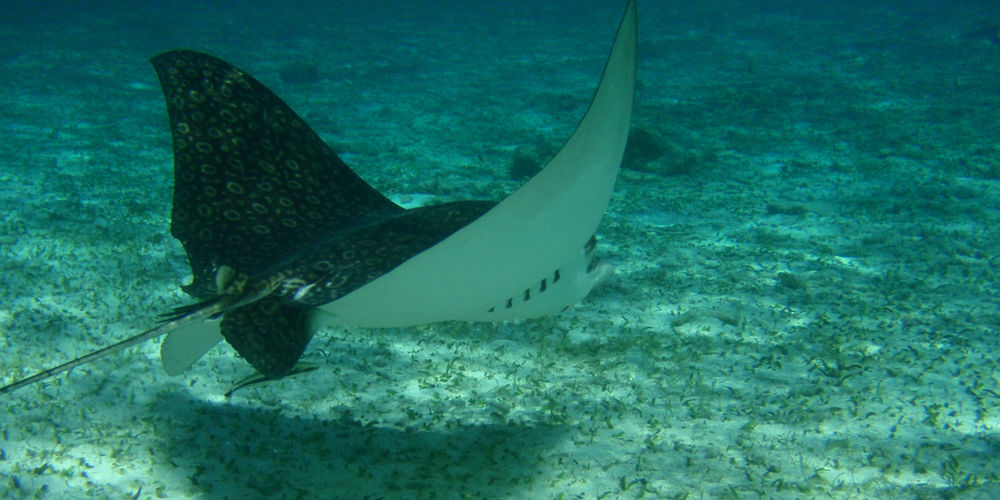
11. Spotted Eagle Ray
Few animals look quite as effortless underwater as a spotted eagle ray. Its dark back is covered in distinctive pale spots, while its wide triangular fins move almost like wings.
One may appear in the distance gliding above the sandy bottom and, for a few seconds, seem to fly through the water. It is the kind of sighting that makes everyone on a snorkel boat start pointing in the same direction.
12. Southern Stingray
The trick with southern stingrays is sometimes noticing them before they move.
They can rest partially buried in the sand with little more than their eyes and outline visible. Once they begin swimming, their broad fins ripple gently through the water, giving them the same almost-flying movement that makes rays so mesmerizing to watch.
Around Ambergris Caye, they can occasionally be spotted from docks as well as on snorkeling excursions.
Look a Little Closer on the Reef
Not everything worth seeing is swimming out in the open. Some of the most fascinating marine creatures of Belize are tucked beneath coral ledges, hiding in crevices or sitting so still that your eyes initially pass right over them.
This is where slowing down really pays off.
13. Caribbean Spiny Lobster
Forget the image of a lobster with two enormous front claws. The Caribbean spiny lobster is better known for its long antennae and hard, spiny shell.
During the day, look beneath coral ledges and into crevices. Sometimes the first thing you’ll notice is a pair of long antennae extending from a hiding place before you realize there is an entire lobster tucked underneath.
Spiny lobster also has an important place in Belize’s fishing traditions and remains one of the country’s best-known seafood species.
14. Queen Conch
You may recognize the beautiful pink interior of a queen conch shell, but seeing the living animal makes the shell far more interesting.
Queen conch move slowly across sandy areas and seagrass beds, where they feed and grow. Conch has also long been connected to Belizean fishing and cuisine, making it part of both the marine ecosystem and the country’s coastal traditions.
15. Caribbean Reef Octopus
Spotting a Caribbean reef octopus can feel like winning an underwater game of hide-and-seek.
Octopuses can rapidly change their color and pattern to blend into rocks, coral and the seafloor. Their camouflage can be so effective that you may be looking directly at one before you realize what you’re seeing.
They are generally more active after dark, which makes finding one a particularly exciting moment on a night snorkel or dive.
16. Barrel Sponge
A large barrel sponge can look like someone placed an enormous vase in the middle of the reef.
Despite their plant-like appearance, sponges are animals. They continually move seawater through their bodies, filtering tiny particles from it for food.
Some barrel sponges grow into impressive structures, and once you start noticing them, you’ll probably find yourself looking for the biggest one on the reef.
17. Jellyfish
Several types of jellyfish can occur in Caribbean waters, and they come in much more variety than the familiar drifting bell shape.
One particularly unusual example is the upside-down jellyfish, which rests on the bottom with its tentacles pointing upward. Jellyfish use stinging cells in their tentacles for feeding and defense, so any jelly is best appreciated with a little space between you and it.
18. Christmas Tree Worm
Some of the reef’s best surprises are tiny.
Christmas tree worms extend brightly colored spiral-shaped crowns from tubes embedded in coral. Once you know what you’re looking for, their miniature tree-like shapes become easier to spot.
Watch carefully if you move closer. At the slightest disturbance, the feathery crown can disappear back inside its tube almost instantly, only to slowly emerge again when things feel safe.
19. Green Sea Turtle
There is something about seeing a green sea turtle underwater that makes almost everyone slow down.
Despite the name, its shell isn’t actually green. The name comes from the greenish color of the fat beneath its shell, which is associated with a diet consisting largely of seagrasses and algae.
In Belize, green turtles can use shallow seagrass habitats for feeding. Watching one graze quietly or rise gracefully toward the surface for air can easily become one of the standout moments of a snorkeling trip.
If sea turtles, rays and reef fish are on your Belize wish list, our guide to snorkeling in Ambergris Caye explains what to expect when exploring the reef from San Pedro.
Marine Mammals of Belize
Not everything you may encounter in Belize’s coastal waters has gills. Marine mammals breathe air, are warm-blooded and nurse their young, just as mammals on land do.
They can also be considerably harder to spot, which makes an unexpected encounter particularly memorable.
20. West Indian Manatee
Belize’s coastal waters, lagoons, mangroves and seagrass habitats provide important habitat for West Indian manatees.
Despite their size, manatees can be surprisingly difficult to see. They spend much of their time moving slowly through shallow water and feeding on aquatic vegetation, and their muted coloring can blend remarkably well with the water around them.
If you’re fortunate enough to encounter one in the wild, enjoy it quietly and from a respectful distance.
21. Bottlenose Dolphin
There aren’t many things that change the mood on a boat as quickly as someone calling out, “Dolphins!”
Bottlenose dolphins occur in Belize’s coastal waters and may sometimes be seen traveling, hunting fish or swimming near boats. Because they are wild animals, there is no schedule and no guarantee, which is exactly what makes an unexpected sighting feel so special.
Where Can You See Marine Creatures in Belize?
For travelers staying on Ambergris Caye, several well-known snorkeling and diving areas are located just offshore.
Hol Chan Marine Reserve is known for its coral, reef fish, sea turtles, nurse sharks and rays. Nearby Shark Ray Alley is especially famous for encounters with nurse sharks and southern stingrays, while Mexico Rocks, north of San Pedro, offers another beautiful snorkeling area with coral formations and tropical marine life.
But don’t assume everything interesting is out at the reef.
The seagrass beds between Ambergris Caye and the barrier reef create important habitat and feeding areas for fish, rays, conch, sea turtles and other marine animals. That means a quiet walk to the end of a dock can sometimes turn into an impromptu wildlife watch if you take a few minutes to look into the water.
If exploring Belize’s marine life is part of your vacation plans, our Planning a Trip to Belize guide covers where to stay, when to visit, transportation, activities and other details that are helpful before you arrive.
Tips for Respectfully Enjoying Belize’s Marine Life
The best wildlife encounter is one where you get a memorable experience and the animal gets to continue behaving naturally.
When snorkeling or diving:
- Keep a respectful distance from marine life.
- Never chase or attempt to touch an animal.
- Avoid touching or standing on coral.
- Keep fins away from the reef and sandy bottom.
- Follow your guide’s instructions.
- Never remove shells, coral or other marine life from protected areas.
- Take photographs and leave the reef as you found it.
One of the easiest things you can do is simply slow down. Look beneath ledges, scan the sandy bottom, and spend a little time watching one section of reef instead of rushing toward the next thing.
The longer you look, the more the reef tends to reveal.
Discover the Marine Creatures of Belize
One moment you may be watching a sea turtle graze quietly through the seagrass, and the next you notice a tiny Christmas tree worm disappearing into the coral. Nurse sharks, rays, parrotfish, octopuses and dolphins may get plenty of attention, but much of the fun comes from discovering the smaller creatures you weren’t expecting to see.
And no two trips underwater are exactly alike. That’s part of what makes exploring the marine creatures of Belize so memorable: every time you put on a mask and look beneath the surface, there is a chance you’ll notice something you missed before.