




Book Now : 1-844-360-1553
Belize Reservations Office
Phone: +501-226-4297
Phone: 1-844-360-1553
WhatsApp: +501-670-4811
E-mail: [email protected]


Close
Belize Activities & Adventures
Lamanai Belize: A Complete Guide to the Ancient Maya City
Oct 7, 2026
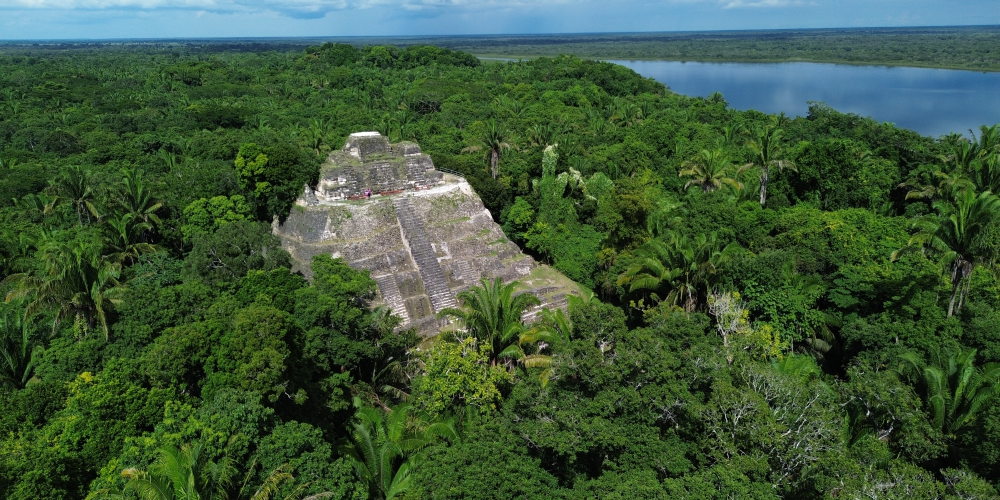
Lamanai is an ancient Maya city in northern Belize with more than 3,000 years of occupation history. Located along the New River Lagoon, it is known for the Mask Temple, High Temple, Jaguar Temple, tropical forest, river approach, and an exceptionally long period of Maya settlement.
Evidence indicates that an agriculturally based settlement had developed here by or before 1500 B.C., and Lamanai remained occupied through the Preclassic, Classic, and Postclassic periods and into the era of Spanish contact.
That extraordinary continuity is what truly sets Lamanai apart.
While many Maya centers experienced major political and population changes near the end of the Classic period, Lamanai continued to evolve. Generations lived here, rebuilt important structures, maintained regional connections, and adapted as the Maya world around them changed.
Its setting is equally memorable. Lamanai developed beside the New River Lagoon, surrounded by tropical forest. Today, many visitors still approach the archaeological reserve by water before walking beneath the forest canopy to discover temples, plazas, carved monuments, and other remains of the ancient city.
Archaeologists have identified more than 700 Maya structures at Lamanai, yet only a small portion of the ancient city has been excavated and studied.
Together, its exceptional history, monumental architecture, river setting, wildlife, and later colonial remains make Lamanai one of the most distinctive Maya sites in Belize.
Lamanai at a Glance
| Quick Fact | What to Know |
| Location | Orange Walk District in northern Belize |
| Setting | Along the New River Lagoon, surrounded by tropical forest |
| Name Meaning | Commonly translated as “Submerged Crocodile” |
| Occupation | More than 3,000 years, one of the longest occupation histories among major Maya sites |
| Structures | More than 700 Maya structures have been identified |
| Main Highlights | Mask Temple, High Temple, Jaguar Temple, Stela 9, ball court, and plazas |
| What Makes It Different | Exceptional historical continuity combined with a river and jungle setting |
| Later History | Two Spanish mission churches and a nineteenth-century sugar mill |
| Best For | Maya history, archaeology, wildlife, river scenery, and travelers who enjoy combining history with nature |
What Is Lamanai?
Lamanai is a major ancient Maya archaeological site in northern Belize.
Although travelers often search for the “Lamanai Mayan ruins,” what you are exploring is the remains of a large city where generations of Maya people lived for thousands of years.
Archaeological research indicates that an agriculturally based settlement had developed at Lamanai by or before 1500 B.C. Extensive evidence of residential and communal architecture appears in later centuries as the community continued to grow.
Lamanai ultimately developed into a large Maya center with monumental temples, plazas, residences, ceremonial spaces, and connections with communities elsewhere in the region.
More than 700 Maya structures have been identified within the site, but only a small portion has been excavated and studied.
That means many of the forested mounds visible around Lamanai are not simply natural hills. Beneath the vegetation are additional structures that once formed part of the ancient city.
Where Is Lamanai?
Lamanai is located in Belize’s Orange Walk District, near Indian Church Village, along the western side of the New River Lagoon.
Its location was an important part of the city’s development.
The lagoon and surrounding waterways provided access to water, fishing, transportation, communication, and regional trade. Canoes allowed people and goods to travel between Lamanai and communities elsewhere in the region.
That relationship with water remains one of the defining features of visiting Lamanai today.
Many visitors make the final approach to the archaeological reserve by boat along the New River. Tropical vegetation lines the banks, and wildlife may be spotted along the way.
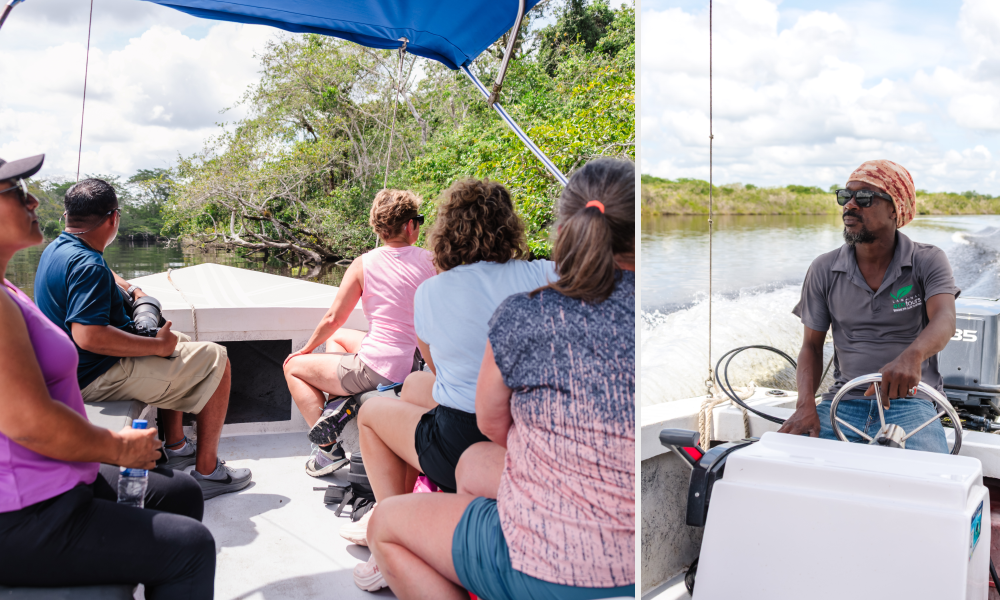
The journey provides a natural introduction to the landscape that helped support Lamanai for generations.
What Does Lamanai Mean?
Lamanai is commonly translated as “Submerged Crocodile.”
It is also notable for retaining a version of its ancient Maya name rather than being known only by a modern name assigned to the archaeological site.
The name is especially fitting given Lamanai’s close relationship with the New River Lagoon and the importance of the surrounding waterways throughout its history.
More Than 3,000 Years of History at Lamanai
Lamanai’s exceptionally long occupation is the most important part of its story.
Rather than representing a single period of Maya civilization, the archaeological site preserves evidence of a community that developed and changed across more than three millennia.
Early Settlement and Growth
Evidence indicates that an agriculturally based settlement existed at Lamanai by or before 1500 B.C.
Over the centuries that followed, the settlement developed into an important Maya center with residences, ceremonial spaces, monumental architecture, and regional connections.
Lamanai was not built all at once.
Temples were expanded, remodeled, and sometimes constructed over earlier buildings. Successive generations reshaped important places while continuing to use a landscape that had already been occupied for centuries.
Lamanai During the Classic Period
During the Classic period, Lamanai was an active city with monumental temples, residences, public spaces, and regional trade connections.
Many of the structures visitors associate with Lamanai today developed through multiple construction phases.
The High Temple, Mask Temple, Jaguar Temple, plazas, ball court, and other structures were part of a much larger community extending beyond the monumental center visible today.
Lamanai Continued After the Classic Period
One of the most remarkable chapters in Lamanai’s history came as the Classic period drew to a close.
Many Maya centers experienced major political disruption, population changes, and declines in monumental construction during the ninth and tenth centuries.
Lamanai changed as well, but it did not simply disappear.
Archaeological evidence shows continued occupation and significant construction during the Terminal Classic period. Activity shifted within the settlement, political and economic relationships changed, and Lamanai continued into the Postclassic period.
Its position beside the New River Lagoon remained important, providing access to transportation, food resources, communication, and regional connections as circumstances changed.
Lamanai therefore provides an important example of continuity through adaptation.
Its significance is not that the city remained unchanged for thousands of years. It is that the community continued to evolve.
Spanish Contact and the Mission Churches
Lamanai was still occupied when Spanish missionaries reached the area during the sixteenth century.
Two Spanish churches were constructed within the community as missionaries attempted to Christianize the Maya population.
The remains of both churches survive at Lamanai today and represent a complicated period of religious pressure, resistance, interaction, and adaptation.
Their presence also makes something about Lamanai immediately clear: the story of the people who lived here did not end centuries before Europeans arrived.
The Colonial Sugar Mill
Another chapter of Lamanai’s history can be seen in the remains of a sugar mill established in the nineteenth century.
The surviving brickwork and machinery stand in striking contrast to the Maya temples elsewhere at the site.
Together, the ancient Maya structures, Spanish churches, and later sugar mill create a historical landscape spanning thousands of years.
What to See at Lamanai
Only part of Lamanai has been excavated and prepared for visitors, but the archaeological reserve contains several impressive structures and monuments.
The Mask Temple
The Mask Temple is one of Lamanai’s most recognizable landmarks.
Large modeled faces flank sections of its central staircase. Created from stone and stucco, these monumental masks are among the archaeological site’s most distinctive features.
The temple developed through multiple construction phases, and archaeologists also discovered important burials within the complex.
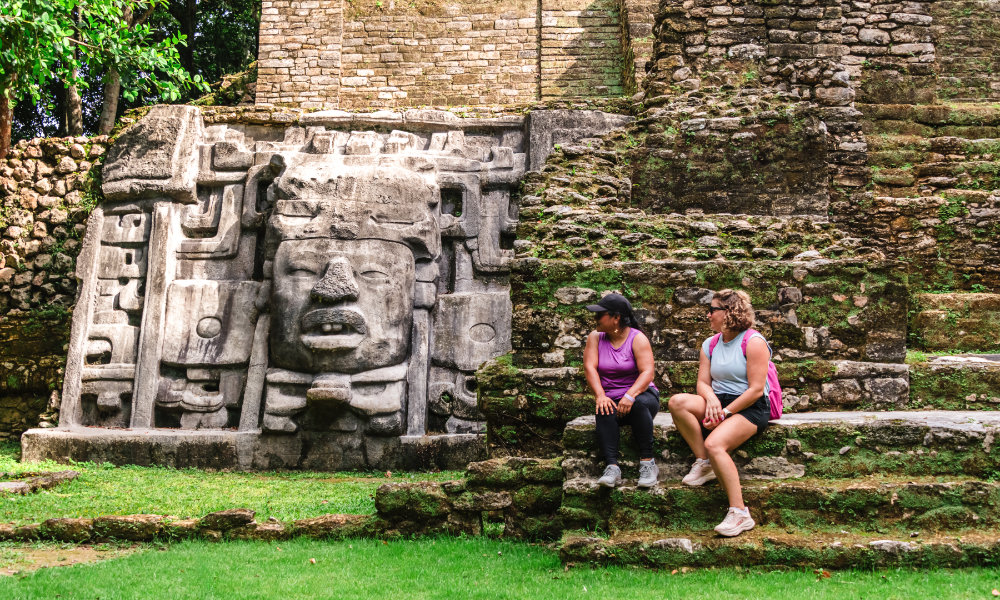
Protective coverings now help preserve portions of the masks, but their size and detail still make this one of the most memorable stops at Lamanai.
The High Temple
The High Temple is one of Lamanai’s largest and most imposing structures.
Its monumental construction began during the Preclassic period, with later generations modifying and expanding the complex.
Standing in the plaza below gives visitors a sense of the scale of Maya architecture and the planning, labor, and resources required to create monumental buildings.
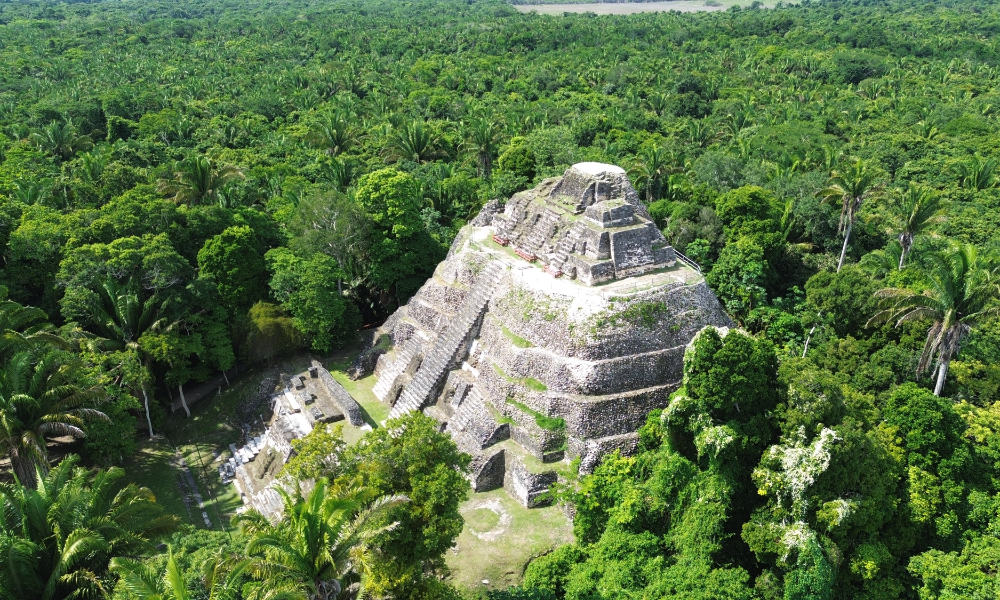
Access to archaeological structures can change for conservation and safety reasons, so visitors should follow current posted rules and their guide’s instructions regarding climbing.
The Jaguar Temple
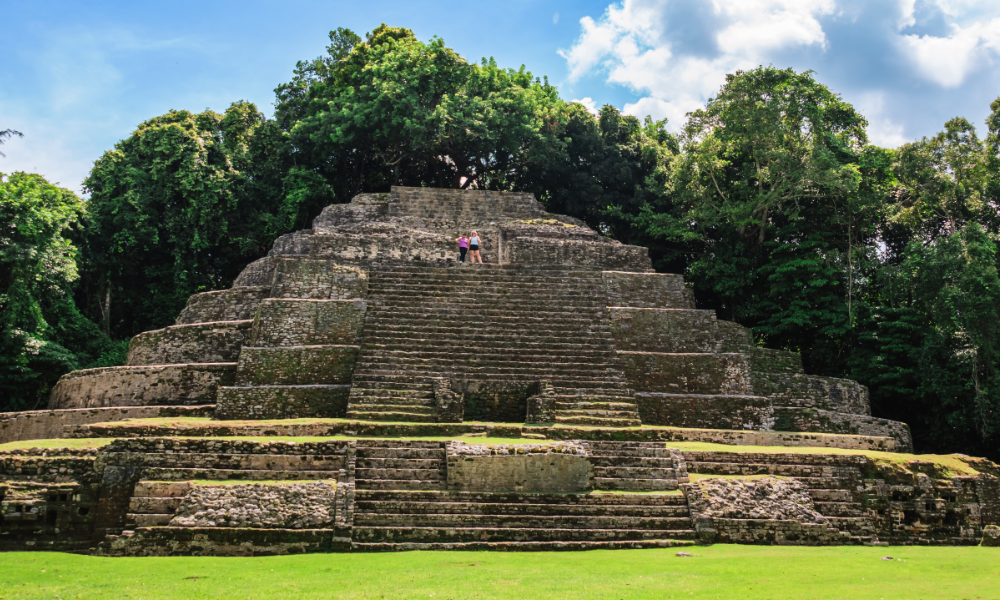
The Jaguar Temple takes its modern name from stylized jaguar features associated with the building.
It became an important focus during later periods of Lamanai’s history and was modified repeatedly over time.
Its broad staircase and surrounding plaza help demonstrate how temples were connected to larger ceremonial and public spaces rather than standing as isolated monuments.
Stela 9
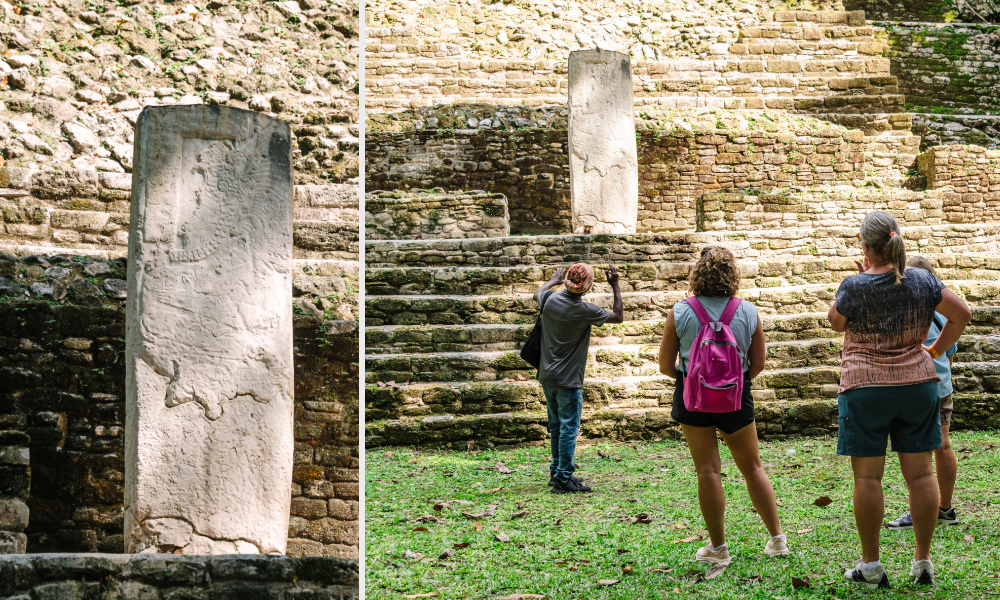
Lamanai also contains carved stone monuments, with Stela 9 among the best known.
Maya stelae could commemorate rulers, dates, important events, and political or ceremonial information. Stela 9 provides another glimpse into Lamanai’s participation in the political and artistic traditions of the Classic Maya world.
The Ball Court and Plazas
Lamanai’s ball court offers another glimpse into the ceremonial and public life of the ancient city.
The Maya ballgame carried social, political, and religious significance across Mesoamerica, making ball courts important features at many Maya centers.
Plazas surrounding Lamanai’s temples also provided spaces for gatherings, ceremonies, movement, and public activity.
As you walk between these areas, look beyond the excavated buildings. Many forest-covered mounds throughout the reserve are also ancient structures.
What Was Life Like at Lamanai?
Monumental temples dominate the landscape visitors see today, but everyday life at Lamanai extended far beyond them.
People farmed, fished, prepared food, raised families, produced tools and pottery, traded goods, and traveled along the surrounding waterways.
Artisans worked with materials including ceramics, stone, shell, bone, and metal, while traders connected the community with regional networks.
Public ceremonies and political activity took place around plazas and temples, but much of daily life unfolded in homes, workshops, agricultural areas, and along the lagoon.
Thinking about those activities helps put Lamanai’s monumental architecture into context.
This was not simply a collection of temples. It was a living city.
The New River and Lamanai
The New River is more than a scenic way to reach Lamanai. It helps explain why the ancient city developed where it did.
For the Maya, rivers and lagoons served as important transportation routes. Canoes allowed people and goods to move through northern Belize and connect with communities farther away.
Today, the New River journey remains a memorable part of visiting Lamanai.
Boats travel through tropical vegetation and freshwater habitats, with opportunities to see birds, crocodiles, iguanas, and other wildlife along the route.
Modern motorboats are very different from ancient Maya canoes, but approaching Lamanai from the water provides a sense of the landscape that helped sustain the community for centuries.
Jungle and Wildlife at Lamanai
Tropical forest surrounds much of the Lamanai Archaeological Reserve, creating an experience where nature and archaeology are constantly intertwined.
Birds are frequently seen along the river and within the forest, while visitors may also encounter iguanas and other wildlife.
Howler monkeys are especially memorable. Their deep calls can carry through the trees and are often heard before the monkeys themselves are spotted.
The jungle also changes the way Lamanai reveals itself.
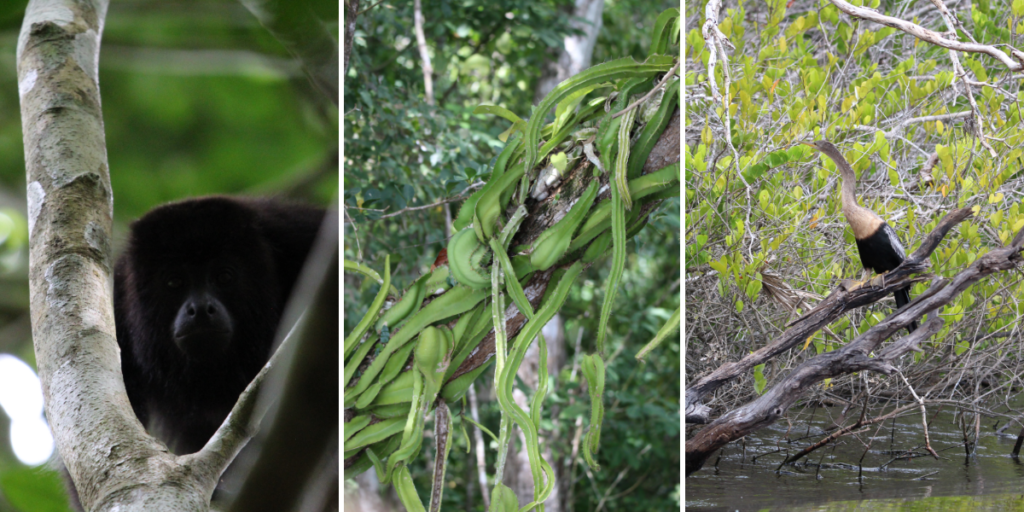
Instead of seeing the entire archaeological site at once, visitors follow forest trails between plazas and structures as different parts of the ancient city gradually emerge through the trees.
What Is It Like to Visit Lamanai Today?
Exploring Lamanai involves walking outdoor trails connecting its principal temples, plazas, ball court, colonial remains, and other archaeological features.
Much of the route passes beneath the forest canopy, but northern Belize can still be hot and humid. Comfortable walking shoes, lightweight clothing, water, sunscreen, insect repellent, and a hat are useful.
A knowledgeable guide adds valuable context by explaining when structures were built, how they changed, what archaeologists discovered, and how each area fits into Lamanai’s larger history.
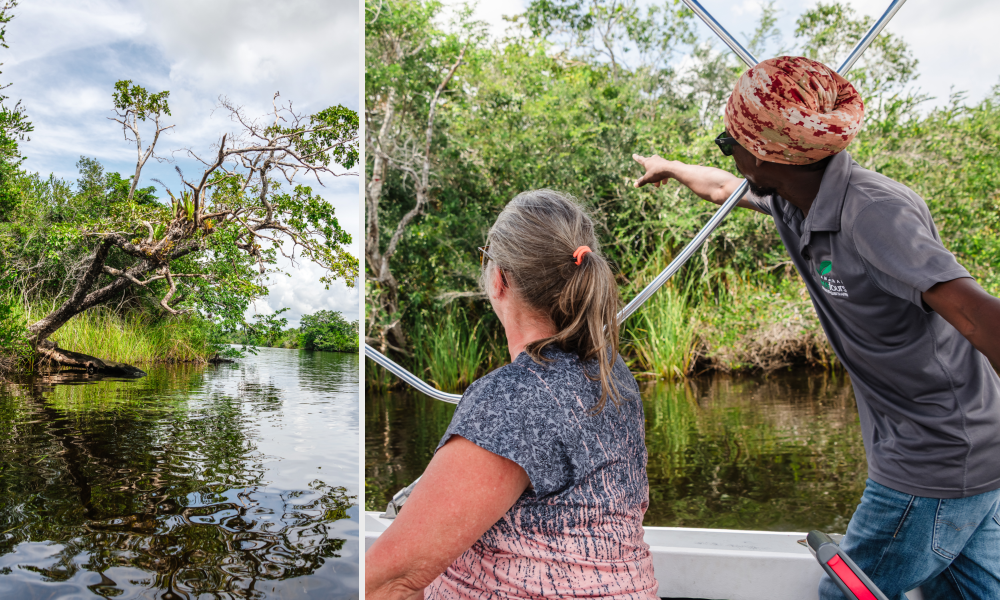
The exact route and amount of time spent exploring the archaeological site can vary by tour, guide, and current site conditions.
Visit the Lamanai Visitor Center
The Lamanai Archaeological Reserve also includes a visitor center where artifacts provide additional context for the archaeological site.
Taking time to see the displays can help connect the monumental buildings outside with the people who lived, worked, and built their community here.
Lamanai Compared with Other Maya Sites in Belize
Belize’s major Maya sites are not interchangeable. Each offers a different way to experience the country’s ancient history.
| Maya Site | Known For | Distinctive Experience |
| Lamanai | 3,000+ years of occupation, monumental temples, masks, and colonial remains | River approach, jungle setting, wildlife, and exceptional historical continuity |
| Xunantunich | El Castillo and elevated views | Crossing the Mopan River before exploring the hilltop city |
| Altun Ha | Formal plazas and Temple of the Masonry Altars | Compact archaeological site with relatively convenient access from Belize City |
| Caracol | Immense scale and the Caana complex | Exploring a major ancient Maya city deep within the Chiquibul Forest |
| Cahal Pech | Early settlement and interconnected courtyards | An intimate hilltop archaeological site near San Ignacio |
What distinguishes Lamanai most is the length and continuity of its story.
Here, visitors can encounter evidence of Maya settlement stretching back more than 3,000 years, monumental architecture from different periods, continued occupation after the Classic period, Spanish mission activity, and later colonial industry within the same landscape.
To compare Lamanai with Xunantunich, Altun Ha, Caracol, Cahal Pech, and other archaeological destinations, explore our complete guide to the Maya sites in Belize.
You can also explore our complete guide to Xunantunich in Belize for a closer look at another of the country’s most important ancient Maya cities.
Lamanai Belize FAQs
How old is Lamanai?
Evidence indicates that an agriculturally based settlement existed at Lamanai by or before 1500 B.C. The community continued through multiple periods of Maya civilization and into the era of Spanish contact, giving Lamanai an occupation history spanning more than 3,000 years.
Why is Lamanai important?
Lamanai is particularly significant because of its exceptionally long occupation history.
Its archaeological record shows how a Maya community developed and adapted across more than three millennia, including periods when many other Maya centers were experiencing major political and population changes.
What does Lamanai mean?
Lamanai is commonly translated as “Submerged Crocodile.” The site is also notable for retaining a version of its ancient Maya name.
How many structures are at Lamanai?
More than 700 Maya structures have been identified at Lamanai, although only a small portion has been excavated and studied.
Many of the forested mounds visible around the archaeological reserve contain ancient structures beneath the vegetation.
What are the main temples at Lamanai?
The best-known structures include the Mask Temple, High Temple, and Jaguar Temple.
Visitors can also see the ball court, plazas, carved monuments including Stela 9, two Spanish church remains, and the nineteenth-century sugar mill.
Why did Lamanai remain occupied for so long?
There is no single explanation.
Its location beside the New River Lagoon provided access to water, fishing, transportation, communication, and regional connections, while the surrounding landscape offered a variety of natural resources.
Lamanai also adapted as circumstances changed. Population patterns, political organization, trade relationships, and the areas of the city being used evolved throughout its long history.
Can you climb the temples at Lamanai?
Access to archaeological structures can change because of conservation, safety, and site-management decisions.
Visitors should follow current posted regulations and instructions from their guide rather than planning a visit around a particular structure being available for climbing.
How to Visit Lamanai
Lamanai can be visited from several parts of Belize.
Travelers staying on Ambergris Caye can experience Lamanai as a full-day mainland excursion, typically combining transportation from the island with a mainland transfer and a boat journey along the New River.
For transportation options, timing, what to bring, tour inclusions, and other practical planning information, continue to our Lamanai Tour from San Pedro: What to Expect guide.
Experience More Than 3,000 Years of History at Lamanai
Lamanai is memorable for its towering temples, carved masks, tropical forest, wildlife, and journey along the New River.
But its extraordinary longevity is what truly distinguishes the ancient city.
For more than 3,000 years, generations lived here, built and rebuilt structures, gathered in plazas, traveled the waterways, traded with other communities, and adapted as the Maya world around them changed.
Today, that long history remains visible across Lamanai’s temples, carved monuments, Spanish church remains, colonial sugar mill, and hundreds of structures still surrounded by forest.
For travelers staying on Ambergris Caye, visiting Lamanai offers an opportunity to experience a completely different side of Belize while returning to the island after the adventure.
Guests of Sandy Point Resorts can speak with our concierge team about visiting Lamanai and other mainland destinations during their stay.

Popular Posts

Follow Us Social Media